
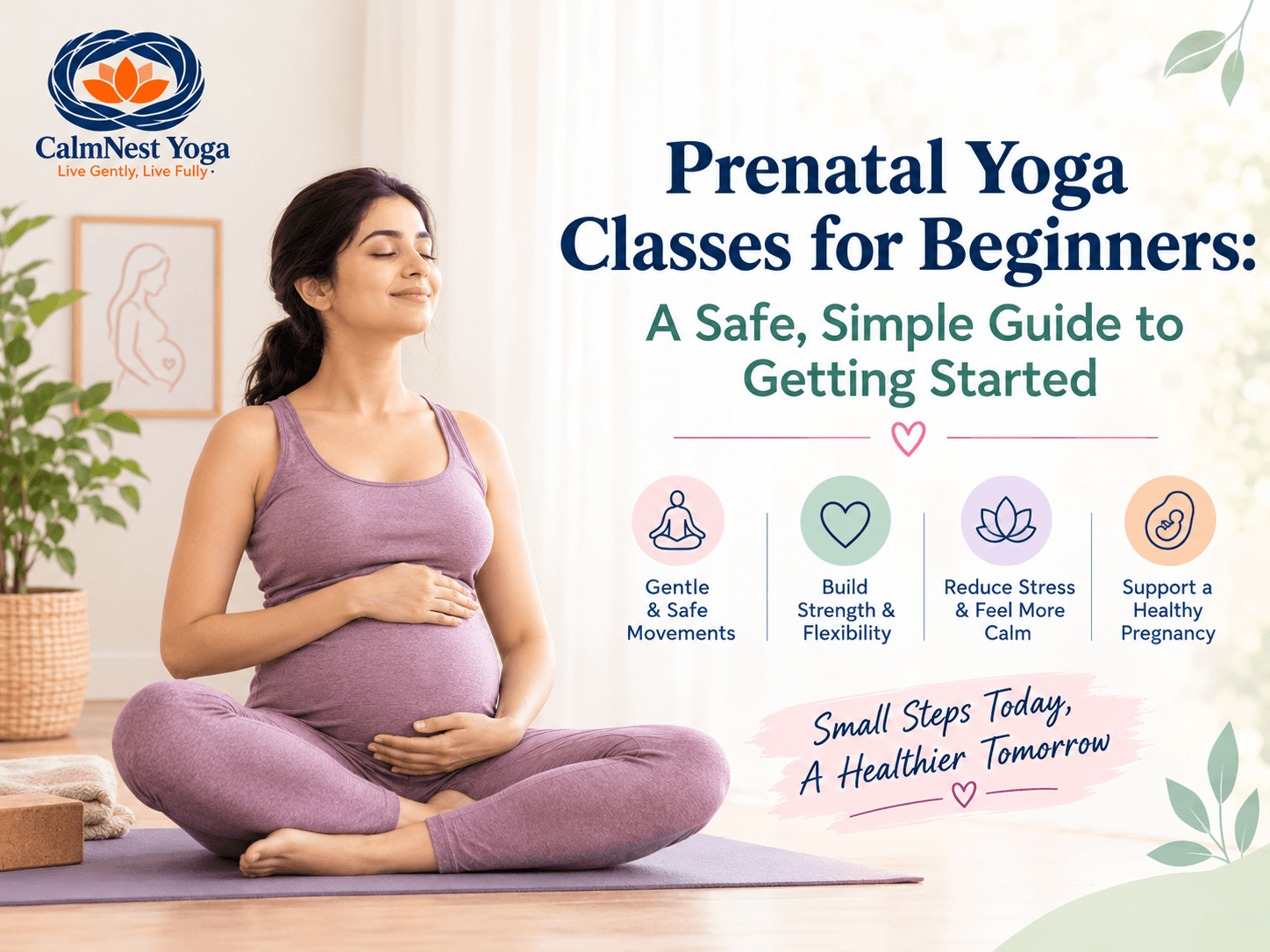
New to prenatal yoga? Learn what beginner classes involve, safe poses, benefits and how to choose the right online sessions. CalmNest Yoga explains.
Pregnancy brings a mix of excitement and uncertainty, and many women start looking for gentle ways to stay active without putting themselves or their baby at risk. If you have never practised yoga before, the idea of joining a class can feel intimidating. You may wonder whether it is safe, what the poses look like, and whether you will be able to keep up. The good news is that prenatal yoga classes for beginners are designed specifically for people in your exact situation — no prior experience required.
This guide explains what beginner prenatal yoga actually involves, how classes are structured, which poses are commonly taught, and how to decide whether an online or in-person format suits you better. It also covers important safety considerations so you can approach your first session with confidence rather than confusion.
What Are Prenatal Yoga Classes for Beginners?
Prenatal yoga classes for beginners are structured yoga sessions adapted for pregnant women who are new to yoga. Unlike general yoga classes, every movement, breath technique, and resting position is modified to account for changes in the pregnant body — particularly the growing belly, shifting centre of gravity, loosening joints, and changing energy levels.
A beginner class typically focuses on:
- Gentle stretching and mobility
- Breathing techniques (pranayama) for calm and focus
- Safe strengthening for the back, hips, and pelvic area
- Relaxation and stress relief
- Awareness of posture and body alignment
The goal is not flexibility or fitness performance. It is comfort, circulation, breath awareness, and preparing the body and mind for labour and postpartum recovery.
If you are completely new to the terminology, it helps to first understand pregnancy yoga asanas and gentle safe poses so the names you hear in class feel familiar.
Who Are Beginner Prenatal Yoga Classes Suitable For?
Beginner classes suit most pregnant women who have been cleared for gentle exercise by their doctor or midwife. That includes:
- Women in their first pregnancy with no yoga background
- Women who exercised before but never tried yoga
- Women returning to activity after a break
- Women looking for a low-impact way to manage pregnancy discomfort
They are generally not a substitute for medical care. If you have a high-risk pregnancy, placenta previa, cervical issues, preeclampsia, or a history of preterm labour, you must speak to your healthcare provider before joining any class.
When Should Beginners Start Prenatal Yoga?
There is no single "correct" week to begin. Many women start in the second trimester when nausea usually settles and energy returns. However, gentle beginner-friendly sessions can also be adapted for the first trimester, focusing on rest, breath, and very light movement.
The key point is that the class should match your trimester. A first-trimester beginner has different needs from someone at 34 weeks. This is why trimester-based prenatal yoga is far safer and more effective than a one-size-fits-all routine.
What Happens in a Typical Beginner Prenatal Yoga Class?
Most beginner sessions follow a predictable, gentle structure. Knowing this in advance removes a lot of first-class anxiety.
1. Centring and Breath Work (5–10 minutes)
You begin seated or lying comfortably on your side. The instructor guides slow breathing, often with one hand on the belly. This calms the nervous system and signals that class has started.
2. Warm-Up and Gentle Mobility (10–15 minutes)
Slow neck rolls, shoulder circles, wrist and ankle movements, and cat-cow-style spinal mobility. Nothing is forced. If a movement causes pulling or pain, you skip it.
3. Standing and Supported Poses (15–20 minutes)
Poses like warrior II with a chair for support, goddess pose, and gentle side stretches. A wall, chair, or yoga block is commonly used for balance.
4. Floor and Seated Poses (10–15 minutes)
Butterfly pose, supported squat, side-lying stretches, and hip-openers. These target the lower back, hips, and pelvic floor — areas that carry extra load during pregnancy.
5. Guided Relaxation (5–10 minutes)
You rest in a supported side-lying position (never flat on the back for long periods after the first trimester). This is often the part beginners appreciate most.
Common Beginner-Friendly Prenatal Yoga Poses
These are the poses most frequently taught in beginner classes. They are gentle, well-supported, and easy to modify.
- Cat-Cow: Relieves back tension and improves spinal mobility.
- Butterfly Pose: Opens the hips and inner thighs.
- Side-Lying Stretch: Releases tension along the sides of the body.
- Supported Squat: Uses a wall or partner for balance; helps prepare the pelvis.
- Warrior II (Supported): Builds leg strength with a chair nearby for stability.
- Legs-Up-the-Wall (Modified): Aids circulation and relaxation; often done with a bolster.
- Child's Pose (Wide-Knee): A resting pose that accommodates the belly.
If you want a slower, stretch-focused approach before committing to a full class, these gentle pregnancy stretches are a good starting point.
Benefits of Prenatal Yoga for Beginners
Beginners often wonder whether it is "worth it" if they cannot do advanced poses. The benefits do not depend on difficulty.
Benefit | What It Means in Practice |
|---|---|
Reduced back and hip discomfort | Gentle stretching and posture awareness ease common pregnancy aches |
Better sleep | Relaxation techniques and breathing help calm the mind before bed |
Improved breathing awareness | Slower, deeper breathing supports relaxation and labour preparation |
Reduced stress and anxiety | Focused breathing and rest activate the parasympathetic nervous system |
Increased body confidence | Learning safe movement builds trust in your changing body |
Preparation for labour | Breath control and pelvic awareness are practical tools |
For readers specifically struggling with rest, this guide on prenatal yoga for sleep goes deeper.
Important: These are general wellness benefits, not medical guarantees. Every pregnancy is different, and yoga does not replace medical advice or guarantee any specific delivery outcome.
Online vs In-Person Beginner Prenatal Yoga: A Fair Comparison
Many beginners in India now start with online classes, especially if they live far from a studio or prefer privacy. Here is an honest comparison.
Criteria | Online Prenatal Yoga | Offline Prenatal Studio | General Online Yoga (Non-Prenatal) |
|---|---|---|---|
Access | From home, any city | Requires travel to studio | From home |
Convenience | High — no commute | Depends on distance | High |
Pregnancy-specific instruction | Depends on provider | Usually yes | Often limited or none |
Travel requirement | None | Yes | None |
Schedule flexibility | Usually high | Fixed class times | Usually high |
Instructor interaction | Live or recorded, depends on provider | In-person corrections | Varies |
Modifications for pregnancy | Depends on provider | Usually available | Often not pregnancy-specific |
Educational resources | Varies by provider | Varies | Varies |
The honest takeaway: online classes win on convenience and access, while studios win on hands-on correction. General online yoga is usually not suitable for pregnancy unless the instructor is trained in prenatal modifications.
If you are weighing this decision carefully, what to know before starting online prenatal yoga classes covers the practical details.
How to Choose the Right Beginner Prenatal Yoga Class
Not every class labelled "prenatal" is genuinely beginner-friendly. Use these criteria:
- Instructor training: Look for prenatal-specific certification, not just general yoga training.
- Class size: Smaller groups mean more individual attention.
- Trimester grouping: Ideally, classes are grouped or modified by trimester.
- Modification options: The instructor should offer alternatives for every pose.
- Clear safety policy: They should ask about your medical history and advise doctor clearance.
- Trial or intro session: A low-commitment way to test the fit.
- Format: Live sessions allow questions; recorded sessions offer flexibility.
If you are searching locally, this guide on prenatal yoga classes near me explains what to check before booking. For city-specific options, see the best pregnancy yoga classes in Mumbai.
How to Prepare for Your First Beginner Class
A little preparation makes the first session much smoother:
- Get medical clearance from your doctor or midwife.
- Wear comfortable, non-restrictive clothing.
- Keep water nearby and stay hydrated.
- Use props: a chair, wall, cushion, bolster, or yoga blocks.
- Eat lightly — not on a full stomach, not hungry.
- Clear some floor space if practising at home.
- Tell the instructor about any pain, complications, or restrictions.
- Stop immediately if you feel dizzy, short of breath, or uncomfortable.
Safety Considerations Every Beginner Should Know
Prenatal yoga is generally considered gentle and low-risk when appropriately modified, but safety must come first.
Avoid or modify:
- Deep backbends and strong twists
- Lying flat on the back for extended periods after the first trimester
- Hot yoga and overheating
- Abdominal crunches or strong core work
- Inversions and arm balances
- Anything causing pain, pressure, or breathlessness
Stop and seek medical advice if you experience:
- Dizziness, faintness, or blurred vision
- Vaginal bleeding or fluid leakage
- Regular painful contractions
- Chest pain or severe shortness of breath
- Reduced fetal movement
This article is general information, not personalised medical advice. Always follow your healthcare provider's guidance.
How CalmNest Yoga Supports Beginners
CalmNest Yoga focuses on prenatal yoga for women who want a safe, guided, and accessible way to stay active during pregnancy. If you are a complete beginner, the approach is built around clear instruction, trimester-appropriate modifications, and a calm pace — not performance.
You can explore the full online prenatal yoga classes offering to understand the format, or begin with the broader collection of online prenatal yoga classes in India designed for practising safely from home.
If you are specifically hoping to prepare for labour, this resource on prenatal yoga for normal delivery explains how breath and movement are used — without making any medical promises.
For a simpler starting point, read this safe and simple guide to online prenatal yoga classes. And if you want to see how the classes are rated by other women, you can review top-rated pregnancy yoga classes.
To ask a question or take the next step, visit the CalmNest Yoga homepage or reach out through the contact page. There is no pressure — just a conversation about what suits your stage of pregnancy.
Final Thoughts
Prenatal yoga classes for beginners are not about touching your toes or mastering difficult poses. They are about creating a few calm, safe moments each week to breathe, move gently, and connect with your changing body. Starting as a beginner is completely normal, and a well-structured class will meet you exactly where you are.
Choose a class that respects your trimester, prioritises safety, and feels comfortable rather than competitive. With the right guidance, prenatal yoga can become one of the most grounding parts of your pregnancy routine.