

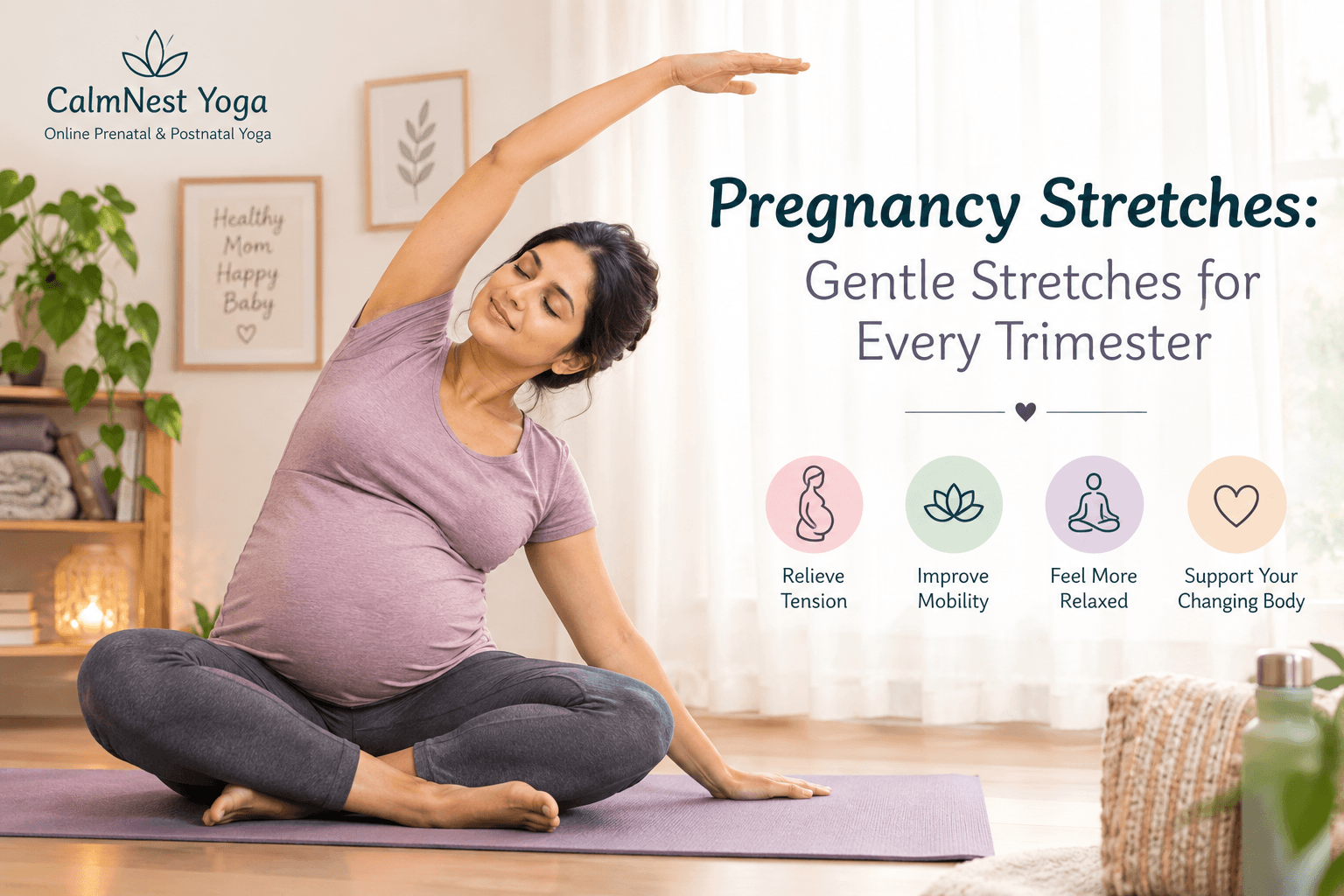
Discover safe pregnancy stretches for every trimester. Gentle stretches for back, hips, and legs. Beginner-friendly guidance for comfort and mobility.
Your body can feel completely different during pregnancy. One day you may feel comfortable walking around, and the next day your hips, back, or legs may feel unusually tight. You might notice it after sitting at a desk for a few hours, after a long day of standing, or simply when you try to get comfortable in bed.
These changes are normal. Pregnancy shifts your posture, balance, and weight distribution. Your centre of gravity moves forward as your belly grows, and your muscles adapt in ways you may not expect. Pregnancy stretches are a gentle way to maintain comfortable movement and support your body through these changes—when done appropriately and with care. The NHS exercise in pregnancy guidance supports gentle movement as part of a healthy routine.
This guide is for you if you are dealing with stiffness, tension, or simply wondering which stretches are suitable during pregnancy. It is not a list of poses to master. It is a practical, trimester-specific guide to moving comfortably.
Why Does Your Body Feel Tighter During Pregnancy?
Pregnancy changes your body in ways that affect how you move and feel.
Your growing belly shifts your centre of gravity forward. To compensate, your lower back curves more, your shoulders may round, and your hips tilt. This can create tension in your back, hips, and shoulders.
Hormonal changes also play a role. Relaxin, a hormone that loosens ligaments in preparation for childbirth, affects all your joints—not just your pelvis. This increased flexibility might sound helpful, but it can also make you feel less stable and more prone to overstretching.
Other factors contribute to tightness:
- Prolonged sitting, especially at a desk or in a car
- Reduced activity levels due to fatigue or nausea
- Changes in sleep positions
- Increased weight and pressure on your legs and feet
- Stress and tension carried in your neck and shoulders
None of this means something is wrong. It means your body is adapting. Gentle movement can help you adapt more comfortably.
Can Pregnancy Stretches Help With Everyday Discomfort?
Stretches during pregnancy may help with mobility, muscle tension, flexibility, relaxation, and body awareness. They can support comfortable movement and may improve how you feel during everyday activities. The NHS best start in life guidance also encourages gentle activity during pregnancy.
But it is important to be honest about what stretching can and cannot do. Stretching does not "treat" medical conditions. It is not a cure for pregnancy pain. It is one part of a healthy movement routine.
If you are experiencing persistent or severe pain, speak with your healthcare provider. Stretching is not a substitute for medical assessment.
Research on pregnancy stretching exercises suggests they may help reduce stress and improve well-being during pregnancy. A systematic review published in PubMed found that prenatal yoga interventions were associated with reduced anxiety and improved quality of life. Another meta-analysis in PubMed noted that pregnancy yoga interventions may support both physical and psychological outcomes, though the evidence varies.
Stretching alone is not the same as a full prenatal yoga practice, but the principles of gentle, mindful movement apply to both.
What Makes a Stretch Pregnancy-Friendly?
Pregnant woman: "I've started feeling stiff around my lower back and hips, especially after sitting for a few hours. I'm worried that stretching might make things worse."
Prenatal yoga instructor: "Gentle movement can feel very different from forcing a stretch. During pregnancy, the goal isn't to become more flexible. It's to find comfortable movement that respects your changing body."
That distinction matters. Safe stretches during pregnancy are not about touching your toes or achieving a deep stretch. They are about comfortable movement within a safe range. The WHO physical activity guidelines emphasise listening to your body and consulting healthcare providers when needed.
A pregnancy-friendly stretch looks like this:
- Slow, controlled movement
- Comfortable range of motion—not maximum range
- No bouncing or jerking
- No forcing or pushing through pain
- Steady, relaxed breathing
- Use of props like cushions, blocks, or a chair for support
- Stable positioning to reduce fall risk
- Modifications based on your trimester and how you feel that day
If a stretch feels sharp, painful, or makes you hold your breath, it is not pregnancy-friendly. Ease back or skip it.
Gentle Pregnancy Stretches to Try
Rather than a generic list of poses, here are gentle stretches for pregnancy organised by common problem areas. Each one includes what it targets, how to approach it gently, and what to avoid. Research on prenatal stretches supports the benefits of gentle movement during pregnancy.
1. Neck and Shoulder Release
Targets: Neck tension, upper-back tightness, shoulder stiffness
How to approach: Sit comfortably. Slowly roll your shoulders forward and back. Gently tilt your head side to side, keeping movements small. You can also do a seated shoulder squeeze, drawing your shoulder blades together without forcing.
What to avoid: Do not roll your head in full circles. Avoid forcing your neck into end-range positions.
Modify or skip if: You feel dizzy or experience neck pain.
2. Gentle Cat-Cow Movement
Targets: Spinal mobility, back tension
How to approach: On hands and knees, or seated in a chair, slowly alternate between arching and rounding your spine. Move with your breath—inhale as you arch, exhale as you round. Keep the movement small and comfortable.
What to avoid: Do not force your spine into extreme positions. Avoid this if your wrists are uncomfortable; seated versions work well.
Modify or skip if: You feel pressure in your abdomen.
3. Supported Hip Mobility
Targets: Hip stiffness, pelvic tension
How to approach: Sit on a cushion with your feet together and knees falling outward. Let gravity do the work. You can also do gentle hip circles while seated or standing with support. These pregnancy stretches for hips can be especially helpful as pregnancy progresses.
What to avoid: Do not press your knees down. Avoid deep lunges or wide squats if they feel unstable.
Modify or skip if: You have pelvic girdle pain; consult your provider about appropriate movement.
4. Seated Side Stretch
Targets: Side body, ribcage, obliques
How to approach: Sit tall on a cushion. Reach one arm overhead and gently lean to the opposite side. Keep the movement small. Breathe into your side body.
What to avoid: Do not compress your belly. Avoid twisting as you stretch.
Modify or skip if: You feel any pulling in your abdomen.
5. Gentle Inner-Thigh Stretch
Targets: Inner thighs, pelvic floor area
How to approach: Sit with legs wide but comfortable. Place cushions under your knees for support. Lean forward slightly from your hips, keeping your back long.
What to avoid: Do not force your legs wide. Avoid deep forward folds.
Modify or skip if: You feel strain in your groin or pelvis.
6. Calf and Ankle Mobility
Targets: Calves, ankles, feet
How to approach: Sit or stand with support. Gently circle your ankles. Point and flex your feet. You can also do a standing calf stretch with hands on a wall.
What to avoid: Do not bounce. Avoid overstretching if you have swelling.
Modify or skip if: You notice sudden swelling, redness, or pain in your calf—seek medical advice.
7. Supported Child's Pose Variation
Targets: Back, hips, relaxation
How to approach: Kneel with knees wide and place a bolster or cushions under your torso. Rest your forehead on the support. Keep your hips high or sit back gently depending on comfort.
What to avoid: Do not do a deep, unsupported child's pose. Avoid if it compresses your belly.
Modify or skip if: You feel breathless or uncomfortable.
8. Gentle Chest and Upper-Back Opening
Targets: Chest, shoulders, posture
How to approach: Sit or stand tall. Interlace your fingers behind your back and gently lift your chest. Or, place your hands on a wall and gently lean forward to open your chest.
What to avoid: Do not force your shoulders back. Avoid if you feel strain in your neck.
Modify or skip if: You have shoulder pain or instability.
Pregnancy Stretching by Trimester
Trimester | Common Changes | Stretching Focus | Useful Modification |
|---|---|---|---|
First Trimester | Fatigue, nausea, hormonal changes, body may not look different yet | Gentle mobility, relaxation, establishing routine | Start slowly; rest when needed; avoid overheating |
Second Trimester | Growing belly, changing posture, hip and back tension | Hip mobility, back comfort, side body, posture support | Use cushions, blocks, chair support; avoid deep twists |
Third Trimester | Larger belly, reduced mobility, balance changes, possible swelling | Supported stretches, hip opening, calf/ankle movement, relaxation | Use wall support, props; avoid lying flat on back for long; modify everything |
Every pregnancy is different. The same stretch may feel fine one week and need modification the next.
First Trimester Pregnancy Stretches
Your body may not look very different yet, but it is already changing. Fatigue and nausea may affect how much you want to move. This is not the time to suddenly increase exercise intensity.
Gentle mobility can be useful. Focus on comfortable movement, breathing, and establishing a routine you can adapt later. If you are new to stretching or yoga, start gradually.
For more detailed guidance on early pregnancy movement, see our article on first trimester yoga.
Second Trimester Pregnancy Stretches
Your belly is growing, your posture is shifting, and your hips and lower back may feel the difference. Balance may also feel different.
This is a good time to use more support—cushions, blocks, a chair, or a wall. Give yourself more space to move. Hip mobility, side stretches, and gentle back movement can feel supportive.
Avoid deep twists and anything that compresses your belly. If a stretch felt fine in the first trimester but feels different now, modify it.
Third Trimester Pregnancy Stretches
With a larger belly, your range of comfortable movement may reduce. Hip and lower-back stiffness are common. Legs may feel tired or uncomfortable. Swelling may occur.
Supported positions become more useful. Wall support, chairs, and props can help you stretch without straining. Gentle calf and ankle movement can support circulation.
If you notice swelling, our article on managing swollen hands and feet in the third trimester discusses practical comfort measures.
Do not assume stretching treats swelling. If swelling is sudden, severe, one-sided, or accompanied by other concerning symptoms, contact your healthcare provider promptly.
Pregnancy Stretches for Common Everyday Problems
"My lower back feels tight after sitting."
Try gentle spinal movement like cat-cow or seated pelvic tilts. Change positions frequently. A short walk can also help. These pregnancy stretches for back pain can be done at home.
"My hips feel stiff."
Try supported hip mobility rather than forcing a deep stretch. Sit on a cushion with feet together and let gravity gently open your hips.
"My legs feel tight after a long day."
Gentle calf and ankle movement can help. Elevate your legs if comfortable. Stay hydrated.
"My shoulders feel tense."
Shoulder rolls, gentle chest opening, and posture awareness can help. If you sit at a desk, take breaks to move.
"I feel uncomfortable at night."
Gentle evening mobility and relaxation can be part of a bedtime routine. Supported positions may help you get comfortable.
These suggestions are general. They are not diagnoses.
Pregnancy Stretches vs Prenatal Yoga
Pregnancy Stretches | Prenatal Yoga |
|---|---|
Main purpose: Maintain mobility and comfort | Main purpose: Holistic movement, breath, relaxation |
Movement variety: Usually focused on specific areas | Movement variety: Includes stretches, strength, balance, breathwork |
Breathing: May include basic breath awareness | Breathing: Structured pranayama and breath-guided movement |
Relaxation: May include brief rest | Relaxation: Often includes guided relaxation |
Trimester modifications: Important but may be self-directed | Trimester modifications: Instructor-led and structured |
Instructor guidance: Optional | Instructor guidance: Central to practice |
Suitable for beginners: Yes, with gentle approach | Yes, with beginner-friendly classes |
Home practice: Easy to do independently | Can be done at home with online prenatal yoga classes |
Overall approach: One part of movement | Broader practice that includes stretching |
Stretching can be one part of pregnancy yoga stretches rather than a completely separate activity. Many women find that guided prenatal yoga makes stretching safer and more adaptable.
How Online Prenatal Yoga Can Make Pregnancy Stretching Easier
If you would rather not figure out stretches for pregnant women on your own, guided prenatal yoga can make it easier to adapt movement to your stage of pregnancy.
CalmNest Yoga — Online Prenatal & Postnatal Yoga offers online prenatal and postnatal yoga sessions that can be practiced from home. You can learn more at calmnestyoga.com.
Practical benefits include:
- Practice from home without travel
- Instructor-led movement with clear guidance
- Trimester-specific modifications
- Ability to ask questions
- Structured sessions that include breathing and relaxation
- Consistency and accountability
- Beginner-friendly options
This is not about claiming a program is the best or guaranteeing outcomes. It is about having guidance that helps you move safely and comfortably.
What Should You Look for in an Online Prenatal Yoga Class?
Whether you choose CalmNest or another provider, here is what to look for:
- Instructor understands prenatal movement
- Instructor knows your trimester
- Modifications are offered
- Pace is comfortable
- No pressure to achieve deep flexibility
- Safety instructions are clear
- You can communicate discomfort
- Sessions include breathing and relaxation where appropriate
- Class is designed specifically for pregnancy
A good class should feel supportive, not competitive. You should feel comfortable asking questions and adapting movements.
Pregnancy Stretching Safety: When to Stop
Safety matters more than flexibility. Keep these principles in mind:
- Do not force a stretch
- Avoid bouncing
- Avoid holding your breath
- Avoid exercising in excessive heat
- Use support if balance feels unstable
- Stop if movement causes pain or makes you feel unwell
The NHS exercise in pregnancy guidance advises pregnant women to avoid becoming overheated and to stop if they feel unwell. The WHO physical activity guidelines recommend regular activity during pregnancy but emphasise listening to your body and consulting healthcare providers when needed.
If you experience warning symptoms—such as bleeding, fluid leakage, severe headache, chest pain, calf pain or swelling, or reduced fetal movement—seek medical care. Do not try to stretch through these symptoms.
When Should You Ask Your Doctor or Midwife?
If you have pregnancy complications or health concerns, you may need individualized exercise advice. This includes conditions such as placenta previa, cervical insufficiency, preeclampsia, or a history of preterm labour.
If you are unsure whether a particular stretch is appropriate for your pregnancy, ask your doctor or midwife. They know your health history and can give you personalised guidance.
This article is general information, not medical advice.
A Simple 10-Minute Pregnancy Stretching Routine
Here is a beginner-friendly example:
- 1–2 minutes — Comfortable breathing
- 1 minute — Neck and shoulder release
- 2 minutes — Gentle spinal mobility (cat-cow or seated)
- 2 minutes — Hip mobility
- 1–2 minutes — Calf and ankle movement
- 1–2 minutes — Gentle side stretch
- 1 minute — Relaxation
This is a general example, not an individualized medical exercise prescription. Adapt it to how you feel. Skip anything that does not feel right.
Pregnancy Stretches Should Feel Supportive, Not Competitive
Pregnancy is not the time to measure your flexibility against someone else's. If one woman can reach her toes and another cannot, neither is doing pregnancy differently. Your body is changing. Your range of motion will change too.
Listen to your body. Adapt movement. Rest when you need to.
How CalmNest Yoga Can Support Your Prenatal Yoga Routine
CalmNest Yoga — Online Prenatal & Postnatal Yoga offers guided sessions that can be practiced from home. If you are looking for structured, instructor-led movement that includes stretching, breathing, and relaxation, you can explore prenatal yoga classes.
If you have questions, you can reach out through the contact page.
If you would rather not figure out pregnancy stretches on your own, guided prenatal yoga can make it easier to adapt movement to your stage of pregnancy. CalmNest Yoga offers online prenatal and postnatal yoga sessions that can be practiced from home.