

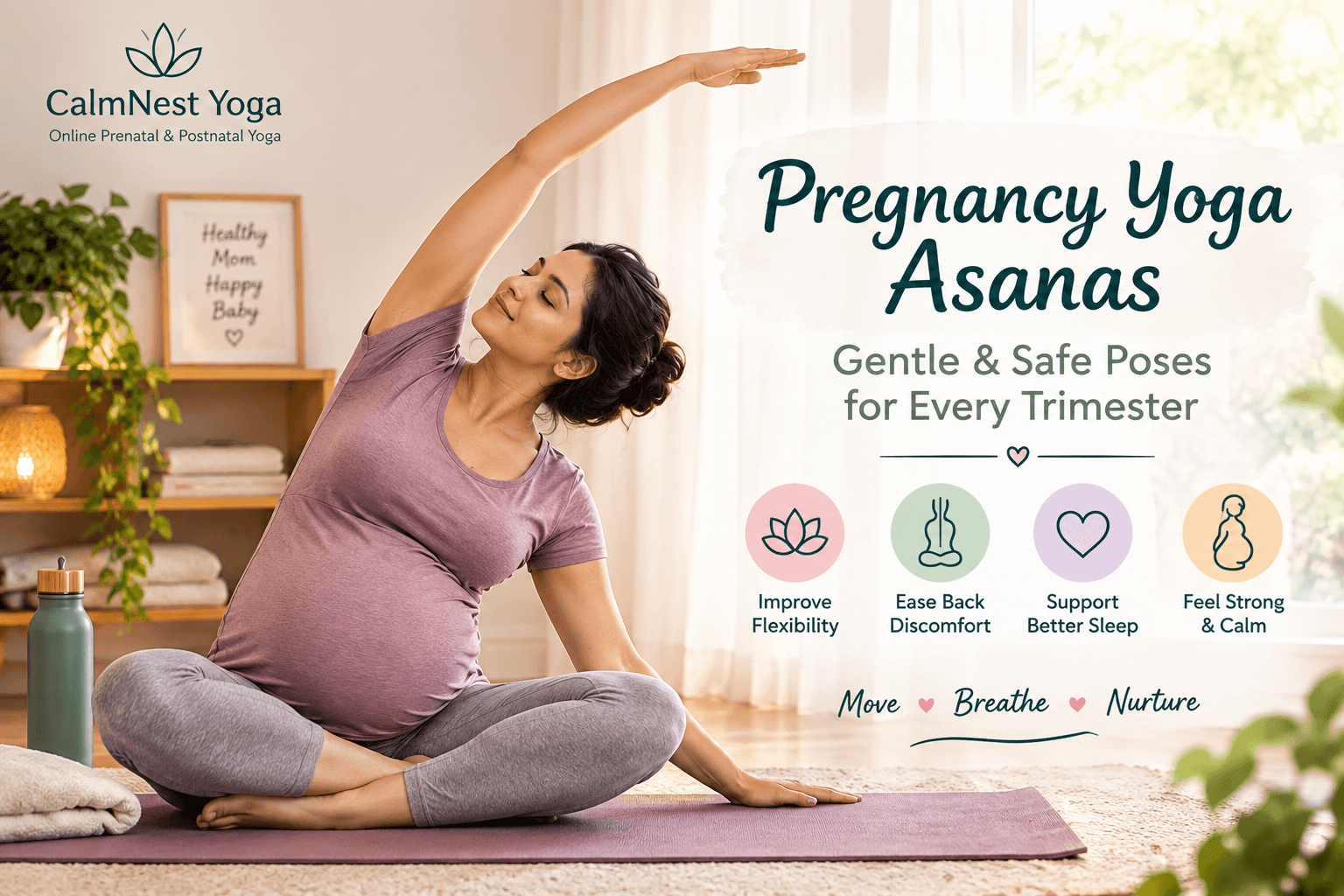
Explore pregnancy yoga asanas with gentle, safe poses for every trimester. Learn beginner-friendly prenatal yoga for flexibility, comfort and relaxation.
You practiced yoga before pregnancy. You knew your flow, your favorite poses, your rhythm. Then you found out you were expecting—and suddenly, everything felt uncertain.
"Can I still do these poses now?"
That's one of the most common questions I hear from expecting mothers. And the answer is: pregnancy doesn't mean you have to stop moving. But your practice does need to change as your body changes.
Pregnancy yoga asanas are not about achieving the deepest stretch or the most advanced pose. They're about comfortable movement, breathing, mobility, and adapting to your changing body. The goal shifts from performance to support.
This guide walks you through which pregnancy yoga asanas may be suitable, how to modify them, what to avoid, and how to build a safe practice—whether you're in your first trimester or your third.
What Are Pregnancy Yoga Asanas?
Pregnancy yoga asanas are yoga postures adapted for the pregnant body. They're not a separate style of yoga—they're traditional poses modified to account for your growing belly, changing balance, and shifting comfort levels.
Common modifications include:
- Wider stance to create space for the belly
- Support from blocks, chairs, or walls for stability
- Reduced depth in stretches and forward folds
- Avoiding uncomfortable positions like deep twists or lying flat on the back for long periods
- Changing balance poses to use wall support or reduce challenge
- Side-lying or supported variations when appropriate
The goal isn't to push through discomfort. It's to move in a way that feels supportive for where you are right now.
Is Yoga Safe During Pregnancy?
For many women with uncomplicated pregnancies, physical activity—including modified yoga—can be appropriate. The American College of Obstetricians and Gynecologists (ACOG) lists modified yoga among activities that can be safe during pregnancy, while recommending that women discuss their exercise routine with their obstetrician or healthcare provider.
That said, "safe" doesn't mean "every pose is fine for everyone."
Pregnancy is not a one-size-fits-all experience. Factors like your fitness level before pregnancy, any complications, your trimester, and how you feel on a given day all matter. Some women can continue a modified practice throughout pregnancy. Others may need to adjust more significantly or focus on gentler movement.
The key is individualized guidance—not universal rules.
How Pregnancy Changes Your Yoga Practice
Understanding why modifications matter helps you make better decisions.
Balance
Your growing belly shifts your center of gravity forward. Poses that once felt stable—like standing balances—may suddenly feel wobbly.
Joints
Pregnancy hormones, particularly relaxin, increase joint mobility. This sounds helpful, but it means you're more prone to overstretching without realizing it.
Abdomen
Your belly needs space. Poses that compress the abdomen or require lying flat on your back for extended periods may become uncomfortable or inadvisable.
Back and hips
Postural changes and the weight of the belly can create tension in the lower back and hips. Gentle mobility often feels better than forced stretching.
Breathing
Pregnancy changes your breathing capacity. You may notice shortness of breath more easily, especially in certain positions.
Energy
Some days you'll feel great. Other days, fatigue or nausea will dictate what's possible. Both are normal.
Pregnancy Yoga Asanas for Beginners
If you're new to yoga or returning after time away, these gentle categories are often a good starting point. But remember: not every pose is suitable for every pregnancy. Listen to your body and consult your healthcare provider.
1. Supported Mountain Pose (Tadasana)
What it is: Standing tall with feet hip-width apart, grounding through all four corners of your feet.
Why include it: Builds body awareness and posture without strain.
Pregnancy modification: Stand with your back near a wall for support. Widen your stance slightly.
What to avoid: Locking your knees or forcing your pelvis forward.
When to stop: If you feel dizzy or unstable.
2. Cat-Cow (Marjaryasana-Bitilasana)
What it is: On hands and knees, alternately arching and rounding your spine with your breath.
Why include it: Gentle spinal mobility that can ease back stiffness.
Pregnancy modification: Use a pillow under your knees. If wrists are uncomfortable, make fists or use forearm support. Move slowly.
What to avoid: Forcing the arch or rounding beyond comfort.
When to stop: If you feel abdominal pressure or pain.
3. Supported Child's Pose Variation
What it is: Kneeling with hips back toward heels, forehead resting on a pillow or block.
Why include it: A restful pose that can release back tension.
Pregnancy modification: Widen your knees to create space for the belly. Place pillows under your torso for support. Avoid if this feels cramped.
What to avoid: Compressing the belly. If it feels tight, skip it.
When to stop: If you feel breathless or uncomfortable.
4. Standing Side Stretch
What it is: Standing tall, reaching one arm overhead and gently leaning to the opposite side.
Why include it: Creates space along the side body and can relieve tension.
Pregnancy modification: Keep the stretch gentle. Don't collapse into the side.
What to avoid: Overstretching or losing balance.
When to stop: If you feel pulling or pain.
5. Supported Squat Variation
What it is: Standing with feet wider than hip-width, slowly lowering into a partial squat with support.
Why include it: May help with hip mobility and prepare for labor positions.
Pregnancy modification: Hold onto a chair or wall. Only go as low as feels comfortable. Place a block under your sitting bones if needed.
What to avoid: Deep squats if you have pelvic pain or are unsure.
When to stop: If you feel pressure, pain, or instability.
6. Bound Angle / Butterfly Variation
What it is: Seated with the soles of your feet together, knees falling out to the sides.
Why include it: Gentle hip opening.
Pregnancy modification: Sit on a cushion or block to tilt your pelvis forward. Don't press your knees down.
What to avoid: Forcing your knees toward the floor.
When to stop: If you feel hip or groin pain.
7. Gentle Warrior Variation
What it is: A standing pose with one foot forward, the other back, arms extended or at heart center.
Why include it: Builds strength and stability in the legs.
Pregnancy modification: Shorten your stance. Use a wall for balance. Keep the back heel lifted if that feels better.
What to avoid: Deep lunges or unsupported balance.
When to stop: If you feel unstable or strained.
8. Supported Hip Mobility
What it is: Any gentle movement that encourages hip movement—like slow hip circles on hands and knees or seated hip shifts.
Why include it: May ease hip stiffness.
Pregnancy modification: Move slowly and within a small range.
What to avoid: Forced or bouncing movements.
When to stop: If you feel pinching or pain.
9. Gentle Seated Breathing/Relaxation
What it is: Sitting comfortably, focusing on slow, steady breathing.
Why include it: Calms the nervous system and supports relaxation.
Pregnancy modification: Sit on a cushion or chair. Support your back if needed.
What to avoid: Straining to breathe deeply. Just slow down.
When to stop: If you feel dizzy or short of breath.
Pregnancy Yoga Asanas by Trimester
Trimester | Common Changes | Yoga Focus | Useful Modification |
|---|---|---|---|
First Trimester | Fatigue, nausea, hormonal shifts, uncertainty | Gentle movement, breathing, maintaining comfort | Rest when needed; avoid overheating; don't suddenly increase intensity |
Second Trimester | Growing belly, changing balance, hip/back discomfort | Wider stance, supported standing poses, hip mobility | Use blocks/walls; avoid deep stretches; create space for the belly |
Third Trimester | Larger belly, balance changes, hip/lower-back discomfort, reduced range of motion | Slower transitions, props, relaxation, supported positions | Use chairs, pillows, bolsters; avoid lying flat on back; prioritize comfort |
Trimester is only one factor. Your individual experience, fitness level, and any complications matter just as much.
First Trimester Pregnancy Yoga Asanas
The first trimester can feel unpredictable. Some women feel energized; others feel exhausted and nauseous. Both are normal.
For a detailed guide, you can read our first trimester yoga guide. The key points:
- Don't suddenly increase intensity. If you were active before, you can often continue with modifications. If you weren't, start gently.
- Avoid overheating. Your body is already working hard.
- Rest when needed. Fatigue is not weakness.
- Focus on gentle movement and breathing rather than pushing for progress.
Second Trimester Pregnancy Yoga Asanas
Many women feel more comfortable in the second trimester. Your belly is growing, but you may still have good energy.
Poses may need to become more spacious:
- Widen your stance in standing poses.
- Use support for balance poses.
- Avoid deep twists that compress the abdomen.
- Modify forward folds to create space for the belly.
- Listen to your hips. They may feel looser due to hormones—don't overstretch.
Third Trimester Pregnancy Yoga Asanas
By the third trimester, comfort and support become priorities.
- Use props generously. Pillows, blocks, bolsters, chairs—they're not cheating.
- Slow down transitions. Moving quickly can affect balance.
- Avoid lying flat on your back for extended periods.
- Focus on relaxation as much as movement.
If you're experiencing swelling in your hands or feet, our article on managing swollen hands and feet in the third trimester may offer some helpful tips. However, sudden or unusual swelling should always be discussed with your healthcare provider.
Which Pregnancy Yoga Asanas May Help With Everyday Discomfort?
"My lower back feels tight."
Gentle spinal mobility—like Cat-Cow—and supported forward folds may feel soothing. Avoid forcing deep backbends.
"My hips feel stiff."
Gentle hip mobility, supported squats, and Bound Angle variation may help. Don't push into pain.
"My shoulders are always tense."
Shoulder rolls, gentle neck stretches, and supported chest opening may release tension.
"My legs feel heavy after sitting."
Gentle movement breaks, ankle circles, and walking may help. Avoid prolonged standing.
"I feel stressed."
Breathing exercises and relaxation practices are a core part of prenatal yoga. They won't solve everything, but they can support your nervous system.
These are general suggestions, not medical treatments. If discomfort is persistent or severe, talk to your healthcare provider.
Pregnancy Yoga Asanas vs Regular Yoga Poses
Aspect | Regular Yoga | Pregnancy-Adapted Yoga |
|---|---|---|
Goal | Flexibility, strength, fitness | Comfort, mobility, relaxation, preparation for birth |
Position modifications | Standard poses | Wider stance, reduced depth, props for support |
Balance | Challenging balances encouraged | Support encouraged; balance poses modified |
Abdominal space | Not a primary concern | Space for the belly is essential |
Props | Optional | Often necessary and encouraged |
Intensity | Can be vigorous | Generally gentler; rest is prioritized |
Instructor guidance | General yoga training | Prenatal-specific training recommended |
Trimester considerations | Not applicable | Central to practice modifications |
Regular yoga isn't "bad." But pregnancy changes what your body needs.
Pregnancy Yoga Asanas vs Simple Pregnancy Stretches
Aspect | Pregnancy Yoga Asanas | Pregnancy Stretches |
|---|---|---|
Movement | Includes flow and transitions | Often static or simple |
Breathing | Integrated breathwork | May or may not include breath focus |
Relaxation | Built-in relaxation practices | Not always included |
Mobility | Whole-body mobility | Targeted stretching |
Strength/Balance | Includes strengthening and balance work | Usually not a focus |
Instructor guidance | Structured prenatal instruction recommended | Can be self-guided |
Suitability for routine | Can form a complete prenatal routine | Best as one component |
Both can be useful. Stretching is one part of prenatal yoga—not a replacement for it.
What Yoga Poses Should Be Modified or Avoided During Pregnancy?
This is not a list of "forbidden poses." It's a list of categories to approach with caution and modify based on your situation.
- Poses that create discomfort or abdominal compression. If it feels cramped, modify or skip.
- Prolonged flat-on-back positions. Later in pregnancy, this may reduce blood flow. Use side-lying or supported positions.
- Hot yoga or overheating. ACOG advises avoiding overheating and activities with increased fall or injury risk.
- High-fall-risk activities. Balance poses should be supported.
- Deep or forced twists. Gentle, open twists may be fine for some; deep twists are usually avoided.
- Extreme backbends. Gentle backbends are often okay; extreme ones are not.
- Unsupported balance poses when stability is poor. Use a wall or chair.
- Anything causing pain, dizziness, or feeling unwell. Stop immediately.
The ACOG infographic on exercises during pregnancy offers practical movement guidance. Modifications depend on the person and stage of pregnancy.
How to Know If an Asana Is Too Much
A pose isn't "successful" because you can go deeper. During pregnancy, comfortable movement matters more than achieving a perfect shape.
Signs a pose is too much:
- Sharp pain
- Forcing or straining
- Bouncing or jerky movements
- Holding your breath
- Feeling unstable
- Abdominal pressure or cramping
- Inability to come out of the pose easily
If any of these happen, stop. Modify or rest. There's no prize for pushing through.
Can You Practice Pregnancy Yoga Asanas at Home?
Yes. Home practice has real benefits:
- Convenient—no travel
- Easy to fit into your routine
- Comfortable environment
- Useful for busy schedules
But it also has limitations:
- It's hard to know if a pose needs modification
- No instructor to observe alignment
- Generic videos may not account for your trimester or individual needs
This is where guided online prenatal yoga can help.
How Online Prenatal Yoga Classes Can Help
CalmNest Yoga — Online Prenatal & Postnatal Yoga offers live sessions designed around different stages of pregnancy. Their prenatal yoga classes include:
- Instructor guidance with pregnancy-specific modifications
- Trimester awareness
- Home-based practice
- Breathing and relaxation
- Structured sessions
- Opportunity to ask questions
- Beginner-friendly approach
A systematic review of prenatal yoga interventions found reductions in anxiety, depression, and perceived stress, along with possible improvements in birth outcomes—though the quality of evidence was rated low to very low. Another review on prenatal yoga effects noted potential benefits for stress, pain, and wellbeing, while acknowledging that more high-quality research is needed.
Yoga is a supportive wellness activity—not a replacement for prenatal medical care.
What Should You Look for in an Online Prenatal Yoga Class?
- Prenatal-specific instruction. Not all yoga teachers have pregnancy training.
- Experienced/qualified instructor. Look for prenatal certification or extensive experience.
- Trimester modifications. A good instructor offers variations based on how far along you are.
- Clear safety guidance. They should emphasize listening to your body and consulting healthcare providers.
- Comfortable pacing. Sessions should feel supportive, not rushed.
- Ability to communicate discomfort. You should feel comfortable speaking up.
- Appropriate use of props. Blocks, pillows, and chairs should be encouraged.
- Breathing and relaxation. These are essential, not extras.
- Beginner-friendly instruction. You shouldn't feel pressured to perform advanced poses.
This guidance helps you choose wisely—even if you choose a different provider.
A Simple Beginner Pregnancy Yoga Routine
This is a general educational example, not an individualized medical exercise prescription.
- Comfortable breathing — 2 minutes
- Gentle shoulder movement — 1 minute
- Cat-Cow / spinal mobility — 2 minutes
- Supported side stretch — 2 minutes
- Gentle hip mobility — 2 minutes
- Supported standing movement — 2 minutes
- Relaxation — 2 minutes
Not every woman should perform every movement. Adapt, modify, or skip based on how you feel and what your healthcare provider advises.
When Should You Stop Yoga and Seek Medical Advice?
Stop exercise and seek medical advice if you experience:
- Vaginal bleeding
- Significant dizziness or fainting
- Chest pain
- Severe shortness of breath
- Fluid leakage
- Painful, regular contractions
- Significant pain
- Any other symptoms your healthcare professional has told you to watch for
This isn't meant to frighten you. It's about safety. People with pregnancy complications or medical conditions may need individualized exercise guidance.
Why Guided Prenatal Yoga Can Be More Helpful Than Choosing Random Poses
Woman: "I found lots of pregnancy yoga poses online, but I don't know which ones are right for my trimester."
Instructor: "That's exactly where structured prenatal guidance can help. The goal isn't to collect as many poses as possible; it's to know how to adapt movement to your body."
Guided classes offer:
- Correct modification for your stage
- Thoughtful sequencing
- Appropriate pacing
- Breathing integration
- Safety awareness
- Consistency and accountability
This isn't about criticizing free content. It's about recognizing that pregnancy is a unique time when guidance matters.
CalmNest Yoga for Online Prenatal & Postnatal Yoga
If you want guidance rather than trying to figure out pregnancy yoga poses on your own, a structured prenatal yoga class can make your practice easier to adapt to your changing body. CalmNest Yoga offers online prenatal and postnatal yoga sessions from the comfort of home.
You can explore their prenatal yoga classes or reach out with questions about what might work for your situation.