
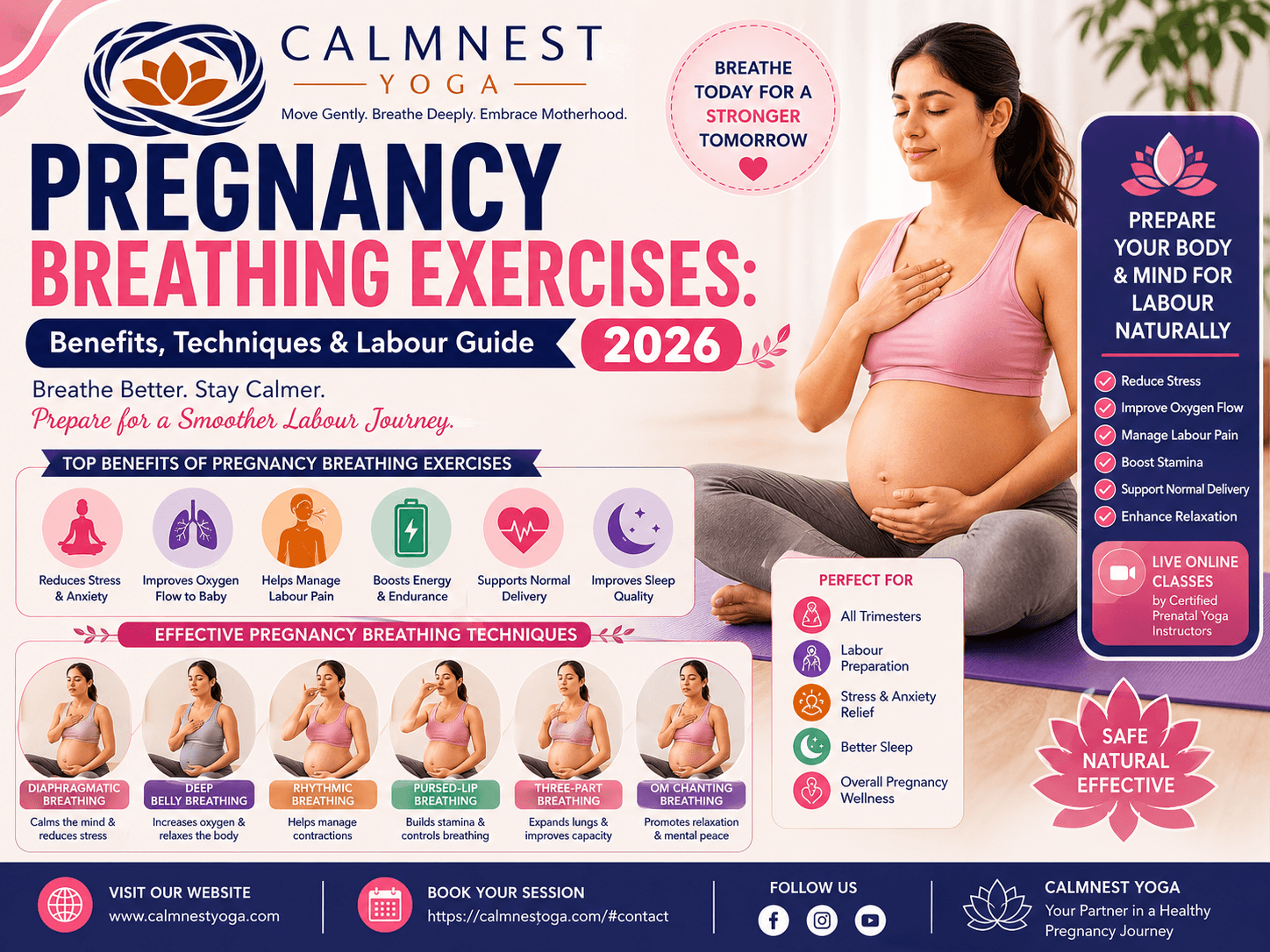
Learn effective Pregnancy Breathing Exercises with CalmNest Yoga to support a healthier pregnancy, reduce stress, improve oxygen flow, and prepare for labour. This 2026 guide covers the benefits, safe breathing techniques, and expert tips for every trimester. Explore more at https://calmnestyoga.com
Breathing is the bridge between your mind and body—and during pregnancy, it becomes your most powerful tool. Many expecting mothers search for pregnancy breathing exercises because they want natural ways to manage stress, prepare for labour, and build confidence for childbirth. The science is compelling: research shows that regular practice of specific breathing techniques can significantly improve pregnancy outcomes, reduce anxiety, and even shorten labour duration.
At CalmNest Yoga, we integrate these proven breathing techniques into our expert-led prenatal yoga classes. This comprehensive guide explores the science behind pregnancy breathing exercises, provides step-by-step instructions for key techniques, and explains how they prepare you for a smoother delivery.
The Science: Why Breathing Exercises Matter in Pregnancy
Breathing exercises are far more than simple relaxation tools—they have measurable physiological effects that benefit both mother and baby.
Clinical Evidence Supporting Breathing Exercises
Recent scientific research reveals remarkable benefits:
- A 2025 randomized controlled trial found that mindfulness-based breathing exercises led to a 59.2% positive increase in overall health profile for pregnant women with pre-eclampsia. The study documented an 80.7% increase in sleep quality, 87.1% increase in energy levels, 73.1% increase in oxygen saturation, and a 6.5% increase in mean fetal movement count .
- Diaphragmatic breathing exercises have been shown to significantly reduce fetal health anxiety and improve effective coping styles for prenatal stress, according to a 2024 randomized controlled study .
- Lamaze breathing techniques during the antenatal period have been found to shorten labour duration and accelerate labour progress, facilitating natural childbirth .
- Research confirms that women who practise prenatal yoga and breathing techniques are 2.5 times more likely to experience a normal vaginal birth, with labour duration reduced by up to 2 hours on average .
How Breathing Affects Labour
Understanding the physiology helps you appreciate why these exercises work:
- Stress Hormone Regulation: When you feel afraid or anxious, your body produces adrenaline, which can prevent the production of oxytocin—the hormone that helps labour progress. Deep breathing helps you fight the urge to panic during contractions, keeping your body relaxed and conserving energy .
- Oxygenation: Proper breathing improves oxygen delivery to your uterus, placenta, and baby. Well-oxygenated muscles work more efficiently during labour .
- Pain Management: Breathing techniques help you "breathe through" contractions, drawing your attention away from pain and reducing the need for additional pain relief .
- Pelvic Relaxation: Coordinated breathing helps relax the muscles around the cervix and birth canal, easing the expulsion of the fetus .
Key Pregnancy Breathing Exercises for Labour Preparation
Here are the most effective and research-backed breathing techniques to practise during pregnancy.
1. Diaphragmatic (Deep Belly) Breathing
This is the foundation of all pregnancy breathing exercises and the most important technique to master.
When to use: Throughout pregnancy for relaxation; at the start and end of each contraction during labour.
How to practice :
- Sit comfortably or lie on your side with pillows for support
- Place one hand on your chest and the other on your belly, just below your ribs
- Inhale slowly and deeply through your nose, feeling your belly expand like a balloon
- Exhale slowly through your mouth with pursed lips, as if gently sighing
- Feel your belly deflate as you breathe out
- Let your shoulders relax a little more with each exhalation
- Practice for 5–10 minutes daily
Why it works: This technique strengthens your diaphragm, increases oxygen flow, and triggers the relaxation response—essential for coping with labour .
Research highlight: A 2024 study demonstrated that diaphragmatic breathing exercises significantly reduce fetal health anxiety and improve coping styles for prenatal stress .
2. Lamaze Breathing Techniques
Lamaze is a well-established childbirth preparation method that blends breathing, gentle exercises, and relaxation techniques. It is designed to ease labour and promote natural birth .
The Lamaze Approach
The Lamaze method uses different breathing patterns for different stages of labour :
Slow, Deep Breathing (For early labour, when contractions are mild):
- Breathe in slowly through your nose or mouth with a gentle, comfortable breath
- Breathe out slowly through your nose or mouth, as if gently sighing
- Let your shoulders relax more with each out-breath
- Listen to the sound of your breath as you exhale
- Use this at the start and end of each contraction to signal the beginning and end of the pain
Light Breathing (For active labour, when contractions are stronger):
- Breathe in and out through your mouth, as if you were slightly out of breath after climbing stairs
- Make a slight sound with your breath out
- Place your hands over your ribs to feel the movement
Panting (For transition phase, when you have an urge to push but the cervix isn't fully dilated):
- Point your chin up towards the ceiling
- Start with a soft breath out through your mouth like a little puff
- Repeat a word like "Blow, Blow, Blow" or "Out, Out, Out"
- This prevents holding your breath and pushing too early
Breathing for Pushing (For second stage, when cervix is fully dilated):
- Be natural—allow your body to tell you what to do
- Push as you breathe out
- Only hold your breath for 5–6 seconds while pushing
- Make grunting or moaning noises if it helps
Lamaze Success Rate: A comparative study found that women who practised Lamaze breathing had a significantly shorter duration of labour compared to those who received standard care .
3. Alternate Nostril Breathing (Nadi Shodhana / Anulom Vilom)
This ancient yogic technique is highly recommended during pregnancy for its calming effects on the nervous system.
When to use: During pregnancy for stress reduction and emotional balance; can be practised throughout all trimesters .
How to practice :
- Sit comfortably with your legs crossed and spine straight
- Block your right nostril with your right thumb
- Inhale deeply through your left nostril
- Once your lungs are full, block your left nostril with your right ring finger
- Exhale through your right nostril
- Inhale through your right nostril, then block and exhale through the left
- Continue this pattern for 5–10 minutes
Why it works: This technique balances the nervous system, reduces stress, promotes emotional balance, and improves oxygenation for both mother and baby . It has been specifically studied for its effects on managing blood pressure during pregnancy .
4. Ocean Sound Breath (Ujjayi Pranayama)
This technique creates a soft ocean-like sound in the throat, helping to focus the mind and regulate breathing.
When to use: During pregnancy for calming the mind; during labour to maintain focus .
How to practice :
- Sit comfortably with your legs folded
- Breathe in through both nostrils
- Constrict your throat muscles slightly (as if fogging up a mirror)
- Exhale through your nose while making a soft "ha" sound from your throat
- Focus on the sound of your breath
Caution: Avoid breath retention or forceful techniques during pregnancy .
5. Equal Breathing (Sama Vritti)
This simple technique helps create balance in the mind and body during anxious pregnancy days .
How to practice :
- Sit comfortably and breathe in and out through your nose
- Count during each inhale and exhale, making sure they are equal (e.g., inhale for 4 counts, exhale for 4 counts)
- Practice for 5 minutes
6. Cooling Breath (Sheetali and Sheetkari Pranayama)
These techniques help regulate body heat and reduce anxiety .
Sheetkari (Hissing Breath):
- Sit in a calm, meditative pose
- Touch your tongue to the roof of your mouth, keeping your teeth together but lips apart
- Inhale through your mouth, feeling cool air, then exhale through your nose
- Repeat 15–20 times
Sheetali (Cooling Breath):
- Sit comfortably and fold your tongue into a tube (if possible)
- Breathe deeply through this tube
- After inhaling, close your mouth and exhale through your nose
7. Mindfulness-Based Breathing
This approach combines breath awareness with meditation, showing exceptional results in clinical research.
How to practice :
- Lie down or sit comfortably
- Pay attention to your breathing without trying to change it
- Place your hand below your belly button and feel it rise and fall
- Practice deep breathing while imagining peaceful scenery
- Focus on inhaling peace and exhaling tension
- Practice for about 10 minutes
Research highlight: A 2025 clinical trial found that mindfulness-based breathing exercises administered for 20 minutes every 8 hours over 72 hours produced dramatic improvements: 59.2% positive health profile increase, 10% decrease in pain, 80.7% improvement in sleep quality, and 73.1% increase in oxygen saturation .
A Complete Guide to Breathing During Labour
Understanding what to expect during labour helps you apply the right breathing technique at the right time.
First Stage of Labour
Early Labour (Cervix 0–3 cm)
- Use slow, deep breathing
- Inhale through your nose, exhale through your mouth with a gentle sigh
- This signals to your body that you are relaxing as the contraction begins and ends
Active Labour (Cervix 3–8 cm)
- Shift to light breathing or shallow, faster breathing
- Breathe through your mouth as if slightly out of breath
- The goal is to stay relaxed during increasingly intense contractions
Transition (Cervix 8–10 cm)
- Use panting if you feel an urge to push before fully dilated
- Blow out short, gentle puffs of air
- This prevents premature pushing and cervical injury
Second Stage (Pushing)
- Allow your body to be natural—follow your urge to push
- Push as you breathe out, not while holding your breath for long periods
- Use grunting or moaning sounds if they help
- Let your legs drop apart, relax your bottom muscles, and sink into the bed
Warning Signs
If you experience light-headedness, dizziness, or tingling in your fingers, you may be hyperventilating. Breathe slowly and gently into your cupped hands or a paper bag to restore normal carbon dioxide levels .
When to Start Practising
- Begin around 14 weeks (second trimester) if you're new to these techniques
- Start at 7 months (28 weeks) or earlier for Lamaze-specific techniques
- Practice daily for best results: 5–10 minutes per day is more effective than longer weekly sessions
- Frequency: Beginners benefit from 2–3 sessions weekly; experienced practitioners can manage 3–5 times per week
Who Should Take Extra Precautions
Consult your healthcare provider before beginning breathing exercises if you have:
- High-risk pregnancy conditions
- Pre-eclampsia or hypertension
- Placenta previa
- Preterm labour risk
- Cervical insufficiency
- Severe medical complications
How Breathing Exercises Complement Prenatal Yoga
At CalmNest Yoga, breathing exercises are integrated with gentle postures to create a complete pregnancy wellness programme. While yoga postures prepare your body physically, breathing techniques prepare you mentally and emotionally for labour. Together, they offer a holistic approach to childbirth preparation.
Internal Links
- Explore Our Prenatal Yoga Classes: https://calmnestyoga.com/prenatal-yoga-classes
- Read: Managing Swollen Hands and Feet in the Third Trimester
- Read: Is it Safe to Have Sex in the Third Trimester?
- Learn About: Maternity Leave Law in India
- Book a Consultation: https://calmnestyoga.com/#contact
- Visit Our Main Website: https://calmnestyoga.com/
Recommended External Links (Evidence-Based Sources)
- World Health Organization – Physical Activity During Pregnancy: https://www.who.int/
- American College of Obstetricians and Gynecologists (ACOG) – Exercise During Pregnancy: https://www.acog.org/
- Mayo Clinic – Prenatal Yoga and Breathing: https://www.mayoclinic.org/
- PubMed – Research on Mindfulness-Based Breathing in Pregnancy: https://pubmed.ncbi.nlm.nih.gov/40366261/
- National Center for Complementary and Integrative Health (NCCIH) – Yoga and Pregnancy: https://www.nccih.nih.gov/
- Evidence Based Birth – Breathing Techniques for Pregnancy: https://evidencebasedbirth.com/
Conclusion
Pregnancy breathing exercises are one of the safest, most accessible, and most effective ways to prepare your body and mind for childbirth. Backed by compelling scientific research—including studies showing 59.2% health profile improvements, reduced labour duration, and increased chances of normal vaginal delivery—these techniques empower you with natural tools for managing stress, pain, and the intensity of labour.
At CalmNest Yoga, we combine these proven breathing techniques with expert-led prenatal yoga to support you throughout your pregnancy journey. Our certified instructors provide trimester-specific guidance, ensuring you practice safely and effectively.
Explore our full range of Prenatal Yoga Classes: https://calmnestyoga.com/prenatal-yoga-classes
Book a Free Consultation: https://calmnestyoga.com/#contact
Visit our Main Website: https://calmnestyoga.com/