
Learn how a yoga block improves alignment, balance, and flexibility. Discover beginner-friendly exercises, safety tips, and expert guidance from CalmNest Yoga.
Many people believe a yoga block is only for beginners or for those who cannot touch their toes. This idea is incomplete. A yoga block is actually one of the most versatile tools in yoga. It helps with alignment, stability, balance, flexibility, comfort, and controlled movement. It brings the floor closer when your hands cannot reach. It supports your body when you feel unsteady. It helps you relax into a stretch instead of forcing it. Whether you are new to yoga or have been practicing for years, a yoga block can change how you move, how you feel, and how you understand your own body.
In this guide, we will explain what a yoga block is, what it is used for, its benefits, beginner-friendly exercises, how to use it correctly, safety tips, and how to choose the best one for your needs. We will also share how CalmNest Yoga uses props like blocks in their online prenatal and postnatal classes to help students practice safely and confidently.
What Is a Yoga Block?
A yoga block is a rectangular prop used to support your body in different yoga poses. It is usually made from foam, cork, or wood. Foam and cork are the most common materials for home practitioners.
Foam blocks are lightweight, soft, and affordable. They offer gentle, cushioned support. They are a good choice for beginners and for restorative poses where comfort matters. According to Yoga Journal, foam is the softest and least expensive material, and it is easy to clean and quite portable.
Cork blocks are denser, heavier, and provide a more solid, grounded feel. They offer excellent grip even when you sweat. They are more durable over time and are preferred by many experienced practitioners. Manduka explains that cork blocks strike a balance between sturdiness and comfort—they are not as heavy as wood blocks but not as flimsy as foam.
Yoga blocks come in different sizes, but the standard dimensions are usually 9 inches by 6 inches by 4 inches. This rectangular shape is intentional. It gives you three distinct heights to work with.
- Low height: The block lies flat, about 4 inches high. This offers the most stability. It is great for standing poses or when you need minimal lift.
- Medium height: The block rests on its long, narrow side, about 6 inches high. This is a versatile option for seated poses and balance work.
- High height: The block stands on its end, about 9 inches high. This provides the most lift. It brings the floor significantly closer for forward folds or seated stretches.
The main purpose of a yoga block is to change the distance between your body and the floor. This allows you to find a version of a pose that works for your unique body. Instead of forcing yourself into a shape that does not fit, you use the block to adapt the pose to you.
What Is a Yoga Block Used For?
The uses for a yoga block are as diverse as the people who practice yoga. Its main functions are to support, align, and adapt poses to your body's needs. Here are the major practical purposes.
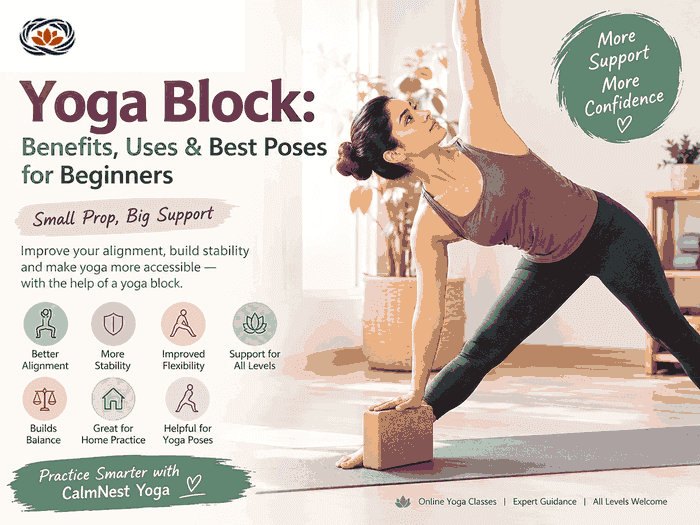
- Bringing the floor closer: In poses like Triangle Pose or Half Moon Pose, if your hand does not comfortably reach the floor, a block acts as an extension of your arm. This prevents you from collapsing your torso or straining your lower back just to touch the ground.
- Supporting balance: For poses that challenge your stability, a block can serve as a point of contact. Gently resting your hand on a block in Tree Pose can give you the confidence to find your center without wobbling.
- Improving alignment: A block provides a clear, physical cue for your body. In a seated forward fold, sitting on a block can tilt your pelvis forward. This makes it easier to hinge from your hips rather than rounding your spine.
- Making poses more accessible: It allows people with tight hamstrings, limited shoulder mobility, or shorter arms to experience the full benefit of a pose. It makes yoga truly inclusive.
- Reducing unnecessary strain: By providing support, a block can reduce strain on your joints, lower back, and neck. It allows you to relax into a stretch rather than forcing it.
- Helping beginners understand positioning: A block gives beginners a tangible reference point. It helps them feel where their body should be rather than guessing.
- Supporting controlled stretching: When you use a block for a supported stretch, like a reclining hamstring stretch, you can control the intensity. You can back off or go deeper with subtle movements. This is safer than pushing blindly into a stretch.
- Improving confidence: When a pose feels accessible, you are more likely to try it. A block removes the fear of not being good enough or not being flexible enough. It builds confidence from the very first class.
A yoga block is a tool for intelligent practice. It helps you listen to your body and respond to its needs rather than ignoring its signals.
Benefits of Using a Yoga Block
A yoga block does not magically increase flexibility. It creates the conditions for flexibility, balance, and strength to develop safely over time. Here is a closer look at the benefits.
Benefit | How a Yoga Block Helps |
|---|---|
Better alignment | It provides a physical foundation, allowing you to stack your joints correctly without collapsing. |
Improved balance | It acts as a stable support point, reducing the fear of falling and allowing you to focus on your center of gravity. |
Greater accessibility | It adapts poses to your body's unique proportions, making yoga available to everyone. |
Support during stretching | It allows you to hold a stretch with support, which can help your muscles relax and lengthen more effectively. |
Improved body awareness | The tactile feedback from a block helps you understand where your body is in space and how to adjust for better alignment. |
Confidence for beginners | It removes the pressure to perform and helps beginners feel successful in poses. |
Controlled range of motion | It helps you work within a safe range. You can use a block to support a limb, preventing you from going too deep too quickly. |
Useful modifications | It provides a simple way to modify a pose when your body needs something different on a given day. |
The key point is this: a yoga block helps you create a more manageable position from which you can practice safely and comfortably. It is this consistent, supported practice that leads to real, lasting change in your body.
Best Yoga Block Exercises for Beginners
Here are six beginner-friendly poses where a yoga block can make a world of difference. Always listen to your body and modify as needed.
1. Supported Tadasana (Mountain Pose)
- Where to place the block: Between your thighs.
- How to perform: Stand tall with your feet hip-width apart. Place a block between your upper thighs and gently squeeze it.
- Why the block helps: It engages your inner thighs and core, helping you find a sense of grounding and stability. It also improves postural awareness by keeping your hips level.
- Safety point: Do not squeeze so hard that you strain. The goal is gentle engagement.
2. Triangle Pose Modification
- Where to place the block: Under your bottom hand.
- How to perform: From a standing position, step your feet wide. Turn your right foot out. Reach your right hand down to a block placed outside or in front of your right shin. Extend your left arm up.
- Why the block helps: It bridges the gap between your hand and the floor. This prevents you from collapsing your torso or straining your lower back. It allows you to keep both sides of your waist long.
- Safety point: Keep your bottom hand resting lightly on the block. Do not press down with excessive force.
3. Half Forward Fold (Ardha Uttanasana)
- Where to place the block: Under your hands.
- How to perform: From a standing forward fold, place your hands on blocks in front of you. Inhale and lift your torso until it is parallel to the floor.
- Why the block helps: It allows you to lengthen your spine rather than round your back. It brings the floor closer, making it easier to find a flat back.
- Safety point: Keep a slight bend in your knees to protect your lower back.
4. Supported Bridge Pose (Setu Bandhasana)
- Where to place the block: Under your sacrum, the base of your spine.
- How to perform: Lie on your back with your knees bent. Lift your hips and slide a block under your sacrum. Rest your weight on the block.
- Why the block helps: It provides a gentle, passive backbend that can release tension in the lower back and hips. It allows you to fully relax in the pose.
- Safety point: Ensure the block is under the bony part of your sacrum, not your lower back. If you feel any pinching, come out of the pose.
5. Seated Forward Fold Modification (Paschimottanasana)
- Where to place the block: Under your sitting bones.
- How to perform: Sit on a block with your legs extended. Inhale and lengthen your spine. Exhale and fold forward, reaching for your shins or a strap around your feet.
- Why the block helps: It tilts your pelvis forward, which makes it easier to hinge from your hips instead of rounding your lower back. This makes the stretch more effective and safer.
- Safety point: Never force the fold. Bend your knees if your hamstrings feel tight.
6. Supported Squat (Malasana)
- Where to place the block: Under your heels.
- How to perform: Come into a squatting position. If your heels lift off the floor, place a block under them.
- Why the block helps: It provides a stable base, allowing you to relax into the squat. This can help improve ankle mobility and hip flexibility over time.
- Safety point: If you have knee issues, check with a professional before doing deep squats.
How to Use a Yoga Block Correctly
Using a block correctly is about more than just placing it under your hand. It is about understanding the three heights and how to use them to support your practice.
- Low height: Use this for standing poses where you need minimal lift. It is also useful under your hands in a plank or Chaturanga for support.
- Medium height: This is the most common height for seated poses and balance work. It offers a good balance of lift and stability.
- High height: Use this when you need the most lift, such as in a seated forward fold or a supported backbend.
One block vs. two blocks: One block is often enough for poses like Triangle Pose or a seated forward fold. Two blocks can be useful for poses like Supported Bridge or for a symmetrical forward fold where you want to rest your hands or forehead. As Cathe Friedrich notes, having two blocks provides multiple height options and allows one for each hand when needed for added balance and stability.
The most important principle to remember is this: the block should support the practice, not force the body into a position. If you are using a block to push yourself deeper into a stretch, you are likely missing the point. The block is there to help you find a position where you can breathe easily and maintain proper alignment. If you feel like you are over-relying on the block, try moving to a lower height or experimenting with a different variation of the pose.
Yoga Block for Flexibility and Balance
It is helpful to understand the difference between flexibility, mobility, balance, and stability.
- Flexibility is the ability of a muscle to lengthen.
- Mobility is the ability to move a joint through its full range of motion with control.
- Balance is the ability to maintain your center of gravity over your base of support.
- Stability is the ability to control joint movement.
A yoga block primarily helps with mobility and balance. By supporting you in a pose, it allows you to move into a range of motion that is accessible today, without forcing. This consistent, supported practice is what gradually improves flexibility.
For example, using a block under your hand in Triangle Pose allows you to keep your spine long. Over time, as your hamstrings and hips open, you may find you need a lower block or no block at all. Similarly, for balance, a block can be a temporary support. In Tree Pose, resting your hand on a block can give you the confidence to find your balance. As your stability improves, you can try hovering your hand just above the block, eventually removing it entirely.
A yoga block does not automatically increase flexibility. It helps you practice in a way that makes flexibility possible.
Yoga Block for Pregnancy
Pregnancy is a time of immense change. Your center of gravity shifts, your posture adapts, and your balance may feel different. A yoga block can be an invaluable prop during this time, offering support and comfort. However, it is crucial to approach your practice with care.
A yoga block can help in several ways during pregnancy.
- Support in seated poses: Sitting on a block can create more space in the pelvis and make seated poses more comfortable.
- Balance support: In standing poses, a block can provide a stable point of contact. This reduces the risk of falling as your balance changes.
- Modifications for forward folds: A block can support your hands in a forward fold, allowing you to keep space for your belly.
However, pregnant readers should always take these precautions.
- Consult your healthcare provider before starting or continuing a yoga practice. Mayo Clinic advises talking to your health care provider before beginning a prenatal yoga program.
- Inform your instructor about your pregnancy so they can offer appropriate modifications.
- Avoid painful or uncomfortable movements.
- Avoid fall-risk situations. Use a wall or a block for support in balance poses.
- Use support when balance changes. As your pregnancy progresses, use props during postures to accommodate changes in your center of gravity.
- Stop immediately if you experience dizziness, pain, or any concerning symptoms.
It is important to note that yoga blocks do not guarantee a normal delivery or prevent pregnancy complications. They are simply a tool for support and comfort.
For those seeking guided, safe practice, CalmNest Yoga offers trimester-specific online prenatal yoga classes. Their expert instructors are trained to help you adapt your practice to your changing body. They ensure you feel supported every step of the way. You can learn more about their prenatal yoga classes here.
Common Mistakes When Using a Yoga Block
Even with the best intentions, it is easy to fall into common traps. Here are mistakes to avoid.
- Choosing the wrong height: Using a block that is too high can compromise your alignment. Using one that is too low may not provide the support you need. Experiment with different heights.
- Forcing a stretch: A block should not be used to push yourself into a deeper stretch. If you feel a sharp sensation, back off.
- Putting weight on an unstable block: Ensure your block is on a non-slip surface and is stable before placing weight on it. Never use a block for a pose like Handstand unless you are experienced and have proper guidance.
- Using a block to compensate for poor alignment: A block should support good alignment, not create it. If your foundation is off, a block will not fix it.
- Trying advanced poses without guidance: Some poses with blocks require specific knowledge. Always learn from a qualified instructor.
- Assuming every pose is safe for everyone: Yoga is not a one-size-fits-all practice. What works for one person may not work for you.
- Ignoring pain: Pain is a signal. If a pose hurts, stop. A block should make a pose feel more accessible, not more painful.
How to Choose the Best Yoga Block
With so many options, how do you choose? Here is a simple breakdown.
- Foam vs. cork: Foam is lightweight and soft. It is great for beginners and restorative yoga. Cork is denser, heavier, and offers better grip. It is ideal for those who sweat a lot or want a more grounded feel.
- Firmness: A block should be firm enough to support you but not so hard that it is uncomfortable. Cork is generally firmer than foam.
- Grip: If you practice a style that makes you sweaty, like Vinyasa or Hot Yoga, a cork block with a natural texture is a better choice. GearLab testing found that cork blocks become more grippy when wet.
- Weight and durability: Cork blocks are heavier but more durable. Foam blocks are lighter and easier to carry but may degrade over time.
- Size and height: Standard blocks are 9 inches by 6 inches by 4 inches. Some brands offer different sizes. If you are taller or have longer limbs, a larger block might be more comfortable.
- Beginner considerations: A foam block is a great starting point. It is affordable and comfortable. Yoga Journal recommends trying props in local studios first to see what you like before purchasing.
- Home practice considerations: If you practice at home, consider buying two blocks. They are useful for a wider range of poses and can be used for restorative practices.
Final Thoughts
A yoga block is more than just a piece of foam or cork. It is a versatile tool that can deepen your practice, improve your alignment, and make yoga accessible to your unique body. By understanding how to use it correctly, you can unlock new levels of flexibility, balance, and body awareness.
Remember, the goal is not to use the block forever. The goal is to use it as a support to help you learn and grow in your practice. Whether you are just starting out or looking to refine your poses, incorporating a yoga block can be a game-changer.
If you are looking for guided instruction on how to safely and effectively use props like yoga blocks, consider exploring the online classes at CalmNest Yoga. Their expert instructors provide clear, compassionate guidance for every level. They help you build a practice that feels good in your body.