
Discover the elements of yoga with CalmNest Yoga. Learn about the 8 limbs of yoga, five traditional elements, asana, pranayama, meditation and yoga philosophy for a balanced practice.
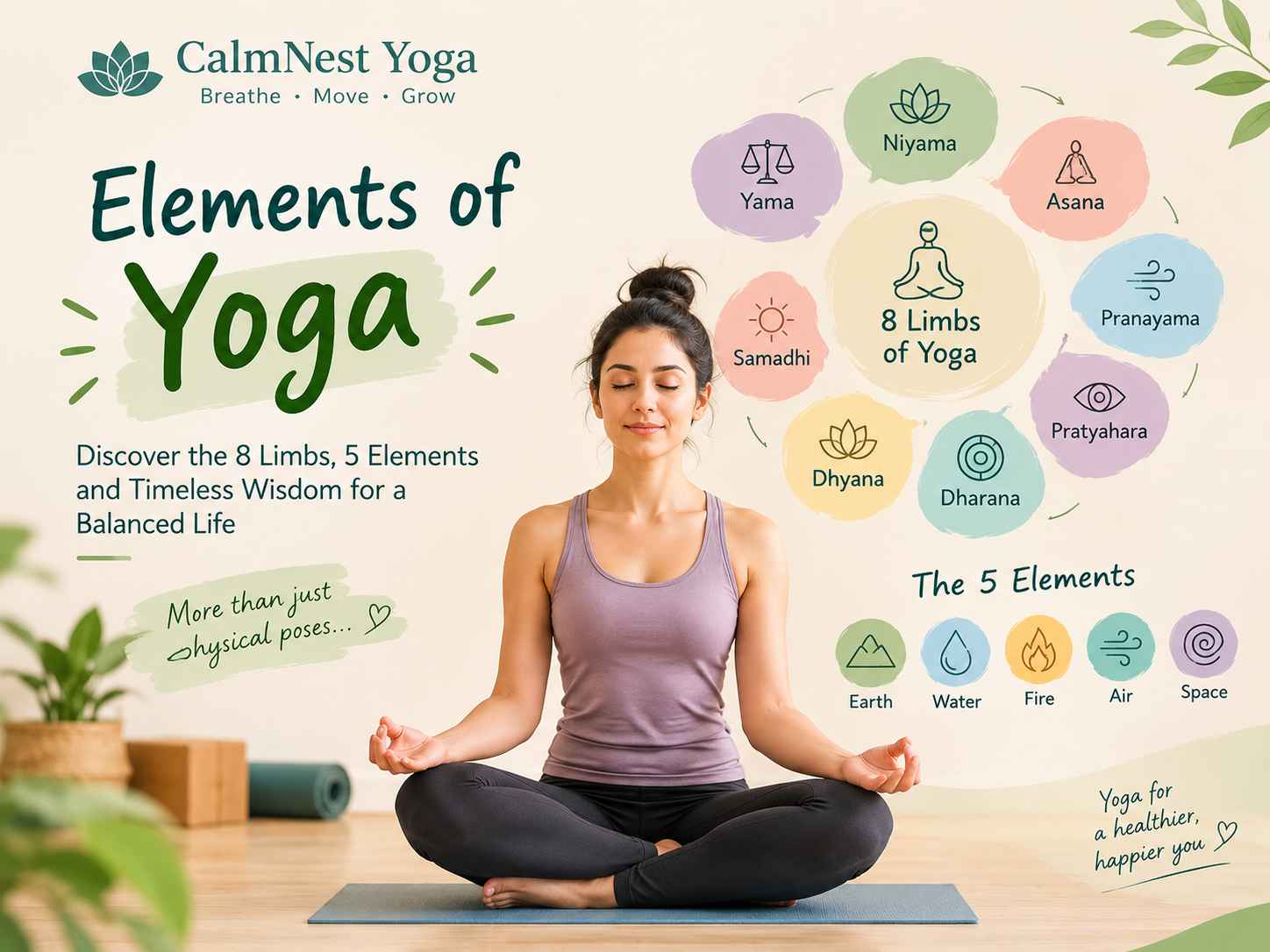
When people ask about the "elements of yoga," they're usually looking for one of two things. Some want to understand the classical eight-limbed path that Patanjali codified over two thousand years ago. Others are drawn to the five great elements—earth, water, fire, air, and ether—that form the philosophical and energetic backdrop of yoga and Ayurveda.
This guide covers both frameworks. By the end, you'll understand not just what the elements are, but how they show up in a real practice and why that matters for your body and mind.
The Classical Elements: Patanjali's Eight Limbs
The most authoritative framework for yoga comes from Patanjali's Yoga Sutras, a text dated roughly to 500 B.C.E. Patanjali described yoga as having eight components, often called astanga (eight-limbed) yoga. You can read a full translation of the Yoga Sutras here to explore the original source.
These aren't sequential steps you complete one by one. They're interwoven dimensions of a single practice.
1. Yama — Moral and Social Conduct
The yamas are ethical restraints: non-violence (ahimsa), truthfulness (satya), non-stealing (asteya), moderation (brahmacharya), and non-possessiveness (aparigraha). For a deeper dive into how these apply in modern life, see this guide to the yamas and niyamas.
2. Niyama — Personal Discipline
The niyamas govern individual conduct: cleanliness (shaucha), contentment (santosha), disciplined effort (tapas), self-study (swadhyaya), and surrender to a higher principle (ishvarapranidhana). We explore these in our CalmNest guide to daily yoga rituals.
3. Asana — Posture
This is what most Western practitioners think of as "yoga." Asanas adjust the body into various postures, building stability and flexibility. Importantly, asanas are meant to prepare the body for stillness, not serve as an end in themselves. Our beginner asana library breaks down each posture step by step.
4. Pranayama — Breath Regulation
Pranayama is the conscious control of breath. Since emotional states alter breathing patterns, regulating the breath becomes a way to regulate the mind and emotions. The Harvard Medical School's overview of breath work explains the physiological mechanisms behind this.
5. Pratyahara — Withdrawal of the Senses
This is the bridge between the physical and mental limbs. Pratyahara means consciously withdrawing attention from external objects and sensory input, preparing the mind for concentration.
6. Dharana — Concentration
Dharana is the practice of focusing the mind on a single point, object, or idea. It builds the mental muscle needed for meditation.
7. Dhyana — Meditation
Dhyana is sustained, effortless awareness. Where concentration requires effort, meditation is the flow state that emerges when focus becomes natural.
8. Samadhi — Absorption
The final limb is a state of complete absorption, where the sense of separate self dissolves. Patanjali describes it as the ultimate aim of yoga: "Yoga is the stilling of the mind into silence."
This framework is comprehensive but somewhat abstract for a beginner. That's where the five elements come in—they give you something tangible to work with.
The Five Great Elements (Panchamahabhutas)
In yoga philosophy and its sister science, Ayurveda, everything in the universe—including your body—is composed of five great elements called panchamahabhutas: earth, water, fire, air, and ether. The CalmNest Yoga offers a useful overview of this framework.
These aren't literal dirt or flames. They represent states of matter and qualities of experience:
Element | Sanskrit | Qualities | In the Body | Associated Chakra |
|---|---|---|---|---|
Earth | Prithvi | Stable, heavy, grounding | Bones, flesh, skin | Root |
Water | Jal/Apas | Fluid, adaptable, nourishing | Blood, saliva, lymph | Sacral |
Fire | Agni | Hot, transformative, energizing | Metabolism, digestion | Solar Plexus |
Air | Vayu | Mobile, light, expansive | Breath, circulation, nerve impulses | Heart |
Ether | Akasha | Spacious, subtle, containing | Cavities, spaces, channels | Throat |
According to Ayurvedic practitioner Anjali Deva, these elements are "the building blocks of the universe, as well as our bodies… everything is created with different combinations of these five elements."
How the Elements Show Up in Practice
You don't need to memorize Sanskrit to benefit from this framework. The elements give you a vocabulary for what you're feeling and what your practice needs.
Earth shows up in standing postures and balances. When you press your feet into the mat and feel grounded, you're drawing on earth's stability. Earth is your anchor when you feel scattered or ungrounded. Our grounding yoga sequence is built entirely around this element.
Water appears in the fluid transitions between poses. It teaches you to soften rather than force, to move with your breath rather than against it. Water is what allows you to adapt your practice to how you actually feel on a given day.
Fire is the heat you generate through dynamic movement. It's also the determination that keeps you present in a challenging pose. Fire transforms—it burns away stagnation and builds tapas, the disciplined heat of practice.
Air is your breath. Breath awareness is one of the most direct tools in yoga: "In just a few moments we can move from anxiety to calm… simply by becoming aware of the way the breath moves." Air is also associated with movement, circulation, and mental agility. Try our breath-focused flow class to experience this directly.
Ether is space—the quality that holds everything else in balance. It's the spacious awareness you cultivate in meditation, the ability to observe thoughts without being swept away by them.
Why These Elements Matter for Your Practice
Knowing the elements isn't just intellectual. It changes how you practice.
If you're feeling anxious and scattered, you might emphasize earth: slow, grounding postures held for longer periods. If you're lethargic, fire: dynamic sequences that build heat. If you're rigid or tense, water: fluid movement and conscious softening. If your mind is chaotic, air and ether: breath work and meditation.
Yoga therapy and Ayurveda both use this elemental framework to restore balance. When an element is out of balance—too much fire causing inflammation, too much air causing anxiety—yoga offers tools to purify and rebalance. The National Center for Complementary and Integrative Health summarizes the evidence base for yoga as a therapeutic practice.
How CalmNest Yoga Approaches the Elements
At CalmNest Yoga, we treat the elements not as abstract philosophy but as practical guides for every class and every body.
Our teachers are trained to assess which elements a student may need more of—and to offer modifications that draw on the appropriate qualities. A student recovering from injury might work primarily with earth and water: stability and gentle flow. Someone preparing for a demanding period at work might focus on fire and air: energy and clarity.
We also teach the eight limbs as an integrated whole, not a checklist. Yama and niyama aren't lectures—they're embedded in how we treat each other in class. Pranayama isn't separate from asana—it's woven through every posture. Pratyahara and dharana aren't reserved for advanced students—they're the natural result of paying attention.
If you're curious about how the elements could shape your own practice, explore our class offerings or book a private session with a teacher trained in elemental yoga therapy. You can also read more on our blog about elemental yoga.